


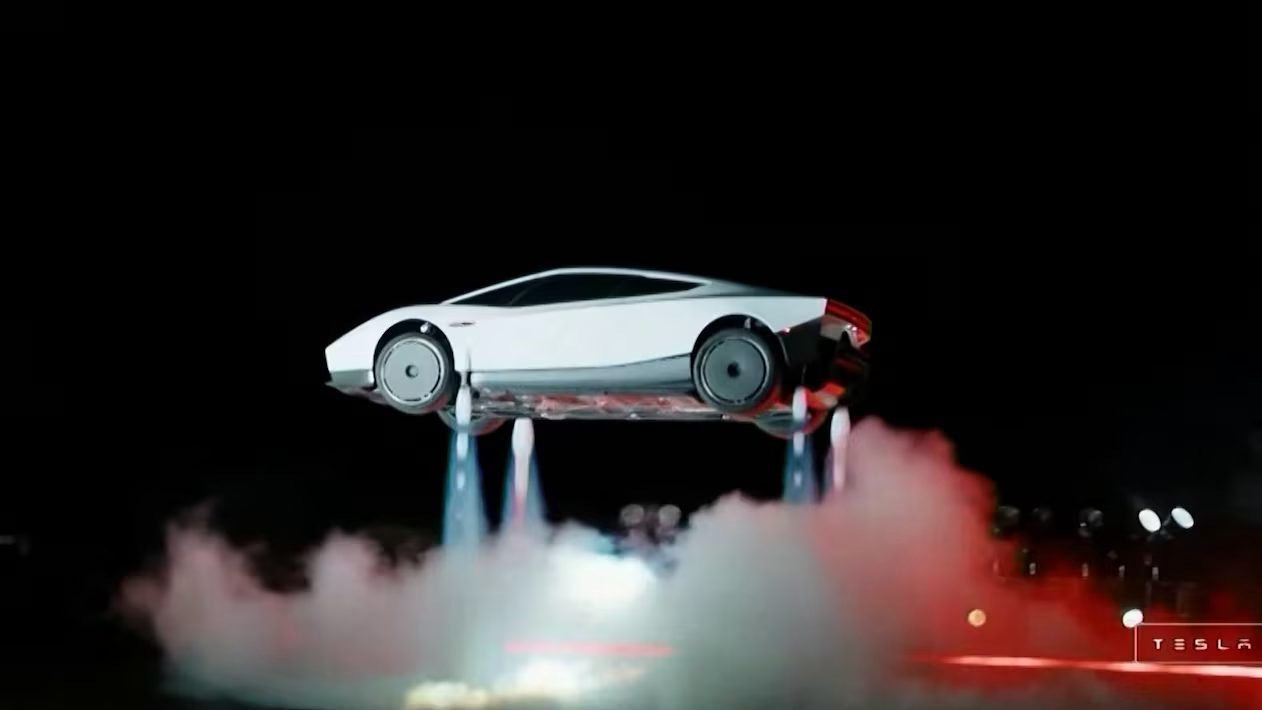
On Thursday 15 October, at a SpaceX test site in Texas, a Tesla drove up a curved ramp, went vertical, drove upside down, jumped, flipped in mid-air and landed on thrusters supplied by SpaceX. It was excellent television. Nobody was driving. Engadget reported that an Optimus robot sat in the driver’s seat for show and that the stunts were programmed. Electrek’s reporter wrote that nobody was in the car at all.
The show ran for under thirty minutes and came with no price and no release date. The next morning Tesla shares rose about 5 percent in premarket trading, according to Reuters. A stunt show can move a share price. Whether it moves the business is the question this essay is about, and a hint at the answer came on stage, almost in passing, in a sentence that deserved more attention than it got.
Elon Musk said the Roadster will be the last Tesla made for a human to drive. CNBC reports that the company intends the rest of its cars to drive themselves. So the loudest product Tesla has shown this year is, by its own chief executive’s account, the exception. Nobody is proposing that every car should be like this, and Musk did not pretend otherwise. He called it “not necessarily a safety-optimized car” and said “I’m not sure it’s necessarily legal in all jurisdictions”. Tesla’s own website says the top version, called Rocket, is “Not approved for public road use”. CNBC puts the economics bluntly: the car “isn’t likely to have any material financial impact”.
That candour is useful, because it tells you what kind of bet this is. It is an experiment with a large budget and an even larger audience, and as an experiment it is well designed. The idea is old: in 2018 Musk floated a “SpaceX option package” with about ten small rocket thrusters for the Roadster. Tesla engineers and SpaceX engineers already work close together, and CNBC notes that Musk’s companies have paid each other and even shared some personnel. So two companies under one leader could ask a question that few others could afford to ask in public: what happens if you bolt a rocket company’s thrusters, pressure tanks and fans onto a sports car? Electrek points out that none of the physics is new, since others have driven upside down on fans and built jumping cars. The novelty is the combination and the budget.
This is how innovation sits in a large organisation when it works. Someone is allowed to explore a thing that is not meant to become the standard, borrows capability from a sister company, and says out loud that it is exploration. I run the same logic with clients in a duller costume: roughly eight in ten projects are validated and business-driving, and one or two in ten are wildcards, kept deliberately small, which often fail and sometimes surprise us. The Roadster is a wildcard with a marketing department.
The same structure comes with a bill that boards should read in advance. Two companies under one controlling leader move faster than companies with independent boards, and the same arrangement is why Tesla’s SEC filings list SpaceX as a related party. Who funds the experiment, who owns the result, who can say stop and who answers when it goes wrong are easier questions before a stunt than after one.
Trouble starts when a wildcard gets sold as a business case, and the reveal shows exactly how. A project of this kind can offer three kinds of proof. The Roadster delivered one.
The first is capability proof: can the thing do it at all? On Thursday night, a prototype could, give or take a driver. Even the headline figure comes with an asterisk. The live run of zero to 60 mph in 0.81 seconds is Tesla’s claim, made after trouble with the timer, and nobody outside the company has measured it.
The second is value proof: will a customer pay, and be better off? Tesla is taking reservations, $50,000 for the Performance version with $5,000 refundable now, and $250,000 for Thrust. Final prices and battery size have not been announced. A deposit is a vote of interest, and also a loan to the company; a depositor quoted by CNBC called it an interest-free one.
The third is delivery proof: will it ship, at that specification, on that date? Musk said production starts “in 2028... actually”, and the crowd laughed. The car was first unveiled in November 2017 with deliveries promised for 2020 and a range of 620 miles. The range claimed now is more than 300.
None of that makes the Roadster a bad experiment. A capability demo is exactly what an exploration produces, and this one produced it with style. It would only become a bad business case if someone budgeted it as one.
Now move this to your side of the building, using a made-up example. Your team pilots an AI tool that reads supplier contracts and flags unusual clauses. At the demo it works beautifully on three contracts the vendor picked. That is capability. Has anyone shown that your lawyers save time on contracts they did not pick, and that the flags change a decision? That is value. Has anyone shown that it keeps working across the whole archive, in every language you sign in, after the person who set it up has left? That is delivery. The demo is built to deliver the first proof. The other two take months and are far less photogenic, which is why the stage prefers the first.
Europe enters this story in its usual role, as the villain. The line goes that Brussels would ban a rocket car and send its founders to Texas. I read the text. The EU type-approval regulation, 2018/858, requires a new car to be approved before it is registered, and it contains a route for this case. Article 39 lets a maker apply for approval of a vehicle with new technologies that fit none of the existing rules, provided it shows at least equivalent safety and environmental protection. A national authority can grant a provisional approval first, valid in its own country, and the Commission authorises it afterwards. So the EU would not ban a rocket car by name. It would ask for proof, in a documented process with several steps. Tesla has announced no EU approval step for any version of the Roadster. In Texas the aviation regulator reportedly said the car is not an aircraft, so no one has to certify it as one, which is freedom for the demo and a gap for the question of who answers if it goes wrong.
Does that cost Europe its daring founders? Regulation is a real friction, and the Commission’s own simplification drive half concedes it. Yet the best study I found on why ambitious founders start or scale elsewhere, a small one from Yale, put capital and talent ahead of regulation. My reading, which is an opinion, is that Europe has few places where a daring bet gets money and a quick, legible path to market, and a rocket car makes the legibility visible.
One more contrast from the same week. Porsche showed a concept called Mission S with a red button on the steering wheel labelled “On your own”, which switches off the driver-assistance systems. It is a concept, and as far as I could find Porsche has not confirmed it for production. It is still a neat counterpart: Tesla’s bet is on how much to hand to the machine, and Porsche’s is on how much to hand back.
On Monday, take one AI pilot in your company and write three lines: what it has shown on capability, on value and on delivery, and whether you are funding it as a validated project or as a wildcard. If the honest answer is “capability only, listed as a project”, you have found the Roadster in your portfolio. It may be a good bet. It belongs in the budget under exploration, with the exploration budget’s expectations.
So here is the question for your next board meeting: which AI pilot in our company has been demonstrated three times and costed never, and what would its second proof look like?
If this was useful, subscribe at https://vanguards.media/subscribe and forward it to the person who signs off your experiments.
David
Sources
CNBC, “Tesla Roadster reveal: what to know about the delayed EV”, 15 Oct 2026. https://www.cnbc.com/2026/10/15/tesla-roadster-reveal-what-to-know-about-the-delayed-ev.html
Car and Driver, “Tesla Roadster revealed”. https://www.caranddriver.com/news/a74145531/tesla-roadster-revealed/
Electrek, “An updated technical look at Tesla’s kick-flipping 0-60 in 1s next-gen Roadster”, 15 Oct 2026. https://electrek.co/2026/10/15/an-updated-technical-look-at-teslas-kick-flipping-0-60-in-1s-next-gen-roadster/
Engadget, launch live blog and thruster/reservation report. https://www.engadget.com/2287518/tesla-roadster-launch-live-blog/ ; https://www.engadget.com/2288437/teslas-redesigned-roadster-cold-gas-thruster-option-reservation/
Reuters, via Investing.com (premarket move, Musk and Moravy quotes). https://www.investing.com/news/stock-market-news/tesla-set-to-unveil-next-generation-roadster-sports-ev-after-years-of-delay-4951021
Tesla, Roadster page and reservation page. https://www.tesla.com/roadster ; https://www.tesla.com/en_US/roadster/reserve
Tesla SEC filings, related-party notes (10-K FY2025 R24; 10-Q Q1 2026 R20). https://www.sec.gov/Archives/edgar/data/1318605/000162828026003952/R24.htm ; https://www.sec.gov/Archives/edgar/data/1318605/000162828026026673/R20.htm
Regulation (EU) 2018/858, Articles 2 and 39. EUR-Lex: https://eur-lex.europa.eu/eli/reg/2018/858/oj/eng ; Article 39 as adopted (copy of the EU text): https://www.legislation.gov.uk/eur/2018/858/article/39/adopted
Yahoo Autos, FAA and NHTSA positions (summarising CBS and Politico). https://autos.yahoo.com/ev-and-future-tech/articles/tesla-taking-250-000-deposits-100100745.html
Porsche Mission S: Porsche Finland https://porsche.fi/mallisto/porsche-mission-s/ ; PistonHeads https://www.pistonheads.com/news/ph-germancars/stunning-mission-s-previews-mid-engined-porsche/51793
Yale SOM, “Europe’s Missing Entrepreneurs” (Dai, Haywood, Liu), Sept 2026. https://som.yale.edu/sites/default/files/2026-09/European_Entrepreneurship_Final-1%20%282%29.pdf